
Across industries, artificial intelligence is beginning to change not only how work is executed, but how organizations decide what is possible. One of the clearest early signals of this shift is emerging in software development, where the economics of experimentation, solution design, and delivery are evolving at remarkable speed.
At NoeSysAI, we recently explored this shift through a simple internal initiative. Inspired by earlier experiences with enterprise budgeting tools such as Hyperion, we rebuilt a lightweight internal budgeting application using AI assisted development tools. What would previously have required long spreadsheet work, repeated iterations, and potentially external development support came together in just a few days.
The significance lies less in the specific application than in what it reveals about changing thresholds. Turning an idea into a working digital solution is becoming faster, cheaper, and more accessible. As these thresholds move, the way organizations structure work and create value is also beginning to evolve.
Software engineering therefore occupies a particularly important position in the current wave of AI adoption. More than another function being optimized, it represents one of the first large scale knowledge domains where productivity gains, capability shifts, and organizational frictions can already be observed in real operating environments.
For a time, the narrative around AI coding assistants remained mixed. A widely discussed 2025 study from METR showed that experienced open-source developers working on familiar repositories sometimes took longer to complete tasks when using frontier AI tools, taking roughly 19 percent more time in certain contexts. Rather than contradicting the broader trend, this finding highlighted a critical adoption reality. Productivity gains do not materialize automatically. They depend on workflow redesign, task framing, review practices, and the maturity of both tools and organizational processes.
Since then, signals from across the technology ecosystem have continued to accumulate. Google has indicated that AI contributes to more than 30 percent of new code in some projects, with engineers focusing increasingly on validation and system level decisions. Microsoft leaders have made similar comments about the growing share of AI assisted code generation within their repositories. Developer research also suggests meaningful time savings in many contexts, even as coordination bottlenecks and information gaps absorb part of these gains. The constraint is gradually shifting from writing code itself to managing the broader system within which code is produced and deployed.
These observations strongly resonate with the conclusions of the recent joint research report between NTT Data and INSEAD, Impact of AI on the IT Industry: Talent Transformation in the AI Era, to which NoeSysAI co-founders contributed. The report highlights that AI adoption has already reached maturity at the task level in areas such as coding and testing, while the new frontier lies in redesigning workflows and redefining talent structures. As automation expands, validation, accountability, orchestration, and governance increasingly become the key differentiators of value creation.
The economic implications are also beginning to surface. Some IT services firms are already facing pressure from clients to share part of the efficiency gains enabled by AI. PwC’s Chief AI Officer publicly acknowledged that clients were asking for their fair share of productivity improvements, and that in certain cases pricing adjustments were already being made. This dynamic signals the early stages of a repricing of parts of the knowledge work economy.
This is where the broader significance of software engineering becomes particularly visible. What is unfolding in development teams is less an isolated technological shift than a preview of deeper changes in how knowledge work is organized, valued, and executed.
It is tempting to view software development as a special case. Code is structured. Developers are highly trained. Digital tools have long been central to their daily activities. From this perspective, one could assume that the implications for other functions will remain limited. Yet another interpretation is emerging. Software development may simply be the first large scale environment where the effects of AI augmentation become clearly observable.
Both overenthusiasm and complacency carry risks. Vendor driven narratives can create unrealistic expectations about the pace of transformation, while legacy systems, governance constraints, and capability gaps continue to slow adoption. Conversely, the belief that disruption will remain confined to junior roles or technical teams looks increasingly fragile.
What software development is showing today is that AI adoption extends beyond automation. It raises the productive ceiling of individuals and teams, compresses the time between insight and execution, redistributes tasks across seniority levels, and forces organizations to rethink where human expertise creates the most value. In many situations, the most significant gains come less from doing the same work faster than from making previously impractical initiatives feasible.
This shift is also broadening the population of people able to innovate within organizations. Low code platforms, natural language interfaces, and agent-based development tools are enabling professionals across functions to experiment with solutions that once required specialized engineering support. A recent Boston Consulting Group study argues that AI is turning employees into potential innovators by lowering barriers to experimentation and accelerating the path from idea to implementation.
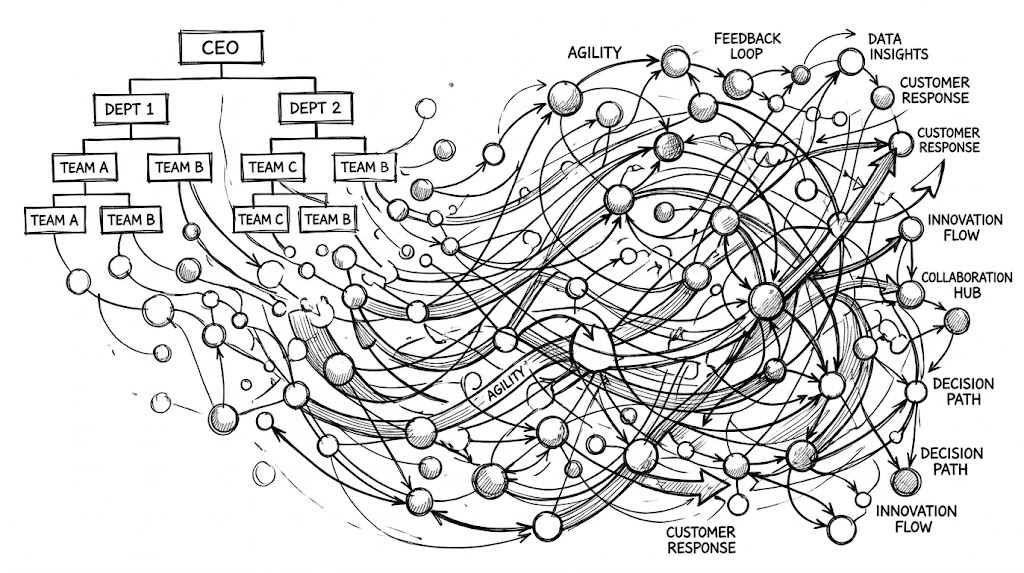
As these dynamics unfold, the implications extend well beyond development teams. When individuals can move more rapidly from analysis to action, organizations must reconsider how initiatives are prioritized, how risks are governed, and how expertise is deployed. The transformation therefore concerns not only productivity, but decision making, coordination, and the allocation of attention across increasingly complex operating environments.
In this context, disciplined adoption becomes critical. Training, experimentation, governance frameworks, and workflow redesign all help translate technological potential into tangible business outcomes. Organizations that move early in a structured way do more than capture efficiency gains. They accelerate their ability to test new operating models, redeploy talent, and align incentives with emerging forms of value creation.
Ultimately, the transformation is not primarily about tools or even productivity metrics. It is about how organizations redefine priorities, distribute decision authority, and compete in environments where the distance between idea and execution continues to shrink.
Software development offers an early window into this transformation. The real question is no longer whether AI will reshape knowledge work, but how quickly organizations will adapt their structures, capabilities, and leadership habits to this new reality.